
What Are the Different SAP Ariba Solutions – Part 4” is the fourth section of this series. In this blog, I will explain the SAP Ariba Supply Chain Collaboration solution—its purpose, need, key features, use cases, and much more.
Before diving into this topic, it is recommended to refer to “What Are the Different SAP Ariba Solutions – Part 3” for better clarity and understanding, as every Ariba solution is closely connected to the others.
Table of Contents
What is Ariba Supply Chain Collaboration
Supply Chain Collaboration is one of the most important and highly used SAP Ariba solutions. It falls under the downstream category and is mainly used for Direct Procurement. Direct procurement refers to the process of acquiring materials, components, and services that are directly incorporated into a company’s final product or service.
Purchase Orders, Consignment POs, Scheduling Agreements, and Info Records are the documents used in Supply Chain Collaboration. If only Purchase Orders are used, many people refer to this solution as Commerce Automation.
This solution is part of SAP Ariba, but the Business Network’s Buyer and Supplier portals are used to perform the scenarios. There is no direct involvement of the Ariba applications in this solution.
What is SAP Business Network
SAP Business Network’s Buyer and Supplier portals play a crucial role in Ariba Buying and Invoicing, as well as in overall procurement.
SAP Business Network is a digital platform where buyers and suppliers connect, collaborate, and conduct business online. The Buyer Network allows organizations to manage procurement, sourcing, orders, and invoices efficiently. The Supplier Network enables suppliers to receive orders, submit invoices, participate in auctions, and manage catalogs. Both networks streamline communication, reduce manual work, and improve transparency between trading partners. Together, they create a seamless, end-to-end procurement ecosystem.
Ariba Supply Chain Collaboration Architecture
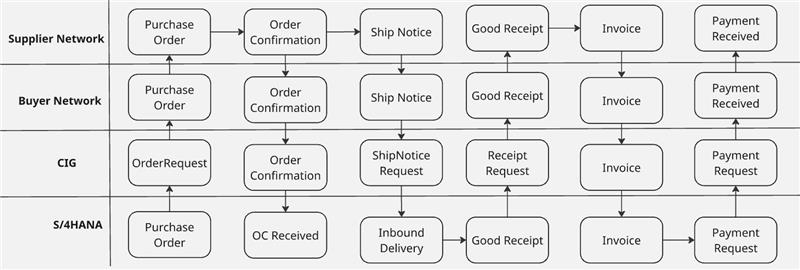
- The starting point of Supply Chain Collaboration is SAP S/4HANA. First, a Purchase Order (PO) is created in S/4HANA. The PO is then triggered in CIG via the OrderRequest idoc and sent to the Buyer and Supplier Networks.
- Once the PO is received on the Supplier Portal, the supplier confirms the order. After confirmation, the buyer receives the Order Confirmation on the Buyer Network. At this stage, the OrderConfirmation idoc is triggered in CIG, and the confirmation is sent back to S/4HANA.
- The next step is also performed by the supplier. After confirming the order, the supplier creates a Ship Notice in the Supplier Portal. This Ship Notice is sent to the Buyer Network, and then the ShipNoticeRequest webservice is triggered in CIG, after which the Ship Notice reaches S/4HANA (also known as an Inbound Delivery).
- Now in SAP S/4HANA, the buyer receives the Ship Notice, indicating that the goods have been delivered. The buyer then creates a Goods Receipt against the Ship Notice. First, this Goods Receipt is sent to CIG and the ReceiptRequest webservice is triggered, and then the Goods Receipt is sent to both the Buyer and Supplier Portals.
- Next, the supplier creates an Invoice against the Goods Receipt. The Invoice is sent to the Buyer Network, and the InvoiceDetailRequest idoc is triggered in CIG. The Invoice is then passed to S/4HANA for posting.
- Once the Invoice is received and posted in S/4HANA, the buyer processes the payment against the Invoice in S/4HANA. Then PaymentRequest will generated in CIG and Finally, the supplier receives the payment.
Important points to keep in mind
- CIG stands for Cloud Integration Gateway. It is a central platform that handles all integration activities. CIG is the older name — the current name is Managed Gateway for Spend Management and Business Network. In this blog, we continue to use the name CIG because many people still commonly refer to it as CIG.
- Message type of Purchase Order, Order Confirmation,Invoice,Payment is IDOC. Message type of Ship Notice Request,Good Receipt is Webservice.
- Cloud Connector (CC) acts as a firewall and secure tunnel between CIG and S/4HANA. Whenever data flows from CIG to S/4HANA, it always passes through the Cloud Connector.
- Always remember, S/4HANA understands XML, while Ariba understands cXML. So whenever data goes from S/4HANA to Ariba, CIG converts the data from XML to cXML. Similarly, when data goes from Ariba to S/4HANA, CIG converts the data from cXML to XML. CIG plays a crucial role in data transfer between both systems.